





‘IFLY’ – Indoor Skydiving

INDOOR SKYDIVING IS REAL FLYING in 'Ifly' state-of-the-art vertical wind tunnels. It is safe for all ages, experience levels and abilities and gives you a indoor sky diving experience for 60 sec. A vertical wind tunnel has fans at the top to draw air through the flight chamber and then push it back down the sides. iFLY Tunnel Systems (formerly SkyVenture) created the vertical wind tunnel industry and has consistently led wind tunnel innovations for 20+ years. It offers ninth generatio...
More

Posted in Uncategorized

First Alert L7: AI Water Monitor Shuts Off Leaks Automatically

White smart shutoff valve with a glowing blue ring on a copper pipe in a home utility room
AI-generated illustration Water damage is one of the most common and costly problems a home can face, and it often starts with a drip nobody sees. Resideo's new First Alert L7 Smart Water Flow Monitor and Shutoff Valve, announced November 17, 2026, aims to catch those slow leaks early and, when needed, close the valve on its own. What Resideo announced In its press release, Resideo describes the L7 as an AI-powered device that applies nearly a decade of water-use analytics to spot unu...
More

LG’s AEROS Intelligence Turns Battery Data Into Decisions

Containerized grid battery units beside a substation at dusk with a glowing data dashboard hologram above
AI-generated illustration Grid batteries are no longer a novelty; they are infrastructure, and infrastructure needs maintenance, warranties and careful accounting. On November 12, 2026, LG Energy Solution Vertech launched AEROS Intelligence, a software platform that turns the data coming off battery energy storage systems (BESS) into decisions for owners and operators. What LG Energy Solution Vertech launched According to the company's press release, AEROS Intelligence is the analytic...
More

Tokyo’s Nanomesh Sensor Is Spun Straight Onto Skin

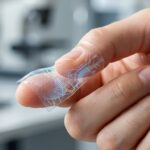
Ultra-thin transparent sensor with fine circuit lines conforming to a fingertip in a bright lab
AI-generated illustration Most wearable sensors are built flat and then pressed onto the body, which is why they wrinkle, peel or feel uncomfortable on curved skin. A team led by Professor Takao Someya and Associate Professor Tomoyuki Yokota at the University of Tokyo, with RIKEN, has flipped the process. According to the University of Tokyo press release, they spin conductive nanofibres directly onto the skin so the sensor takes the shape of whatever it lands on. Fabricating the sens...
More

CSUN’s ELFNet AI Maps Electron Bonding 350x Faster

Glowing crystal lattice of atoms between a layered neural network and a colorful electron density map
AI-generated illustration Finding a new material is often a story of waiting for computers. When chemists hunt for compounds that could superconduct or store energy in unusual ways, they may need to screen millions of candidates, and each one can demand heavy quantum-mechanical calculations. A team at California State University, Northridge (CSUN) says it has found a way to skip much of that wait. Their AI model, ELFNet, predicts a key chemical-bonding map 350 times faster than tradition...
More

Google’s Gemini 4 Neon Targets Coding and Enterprise Work

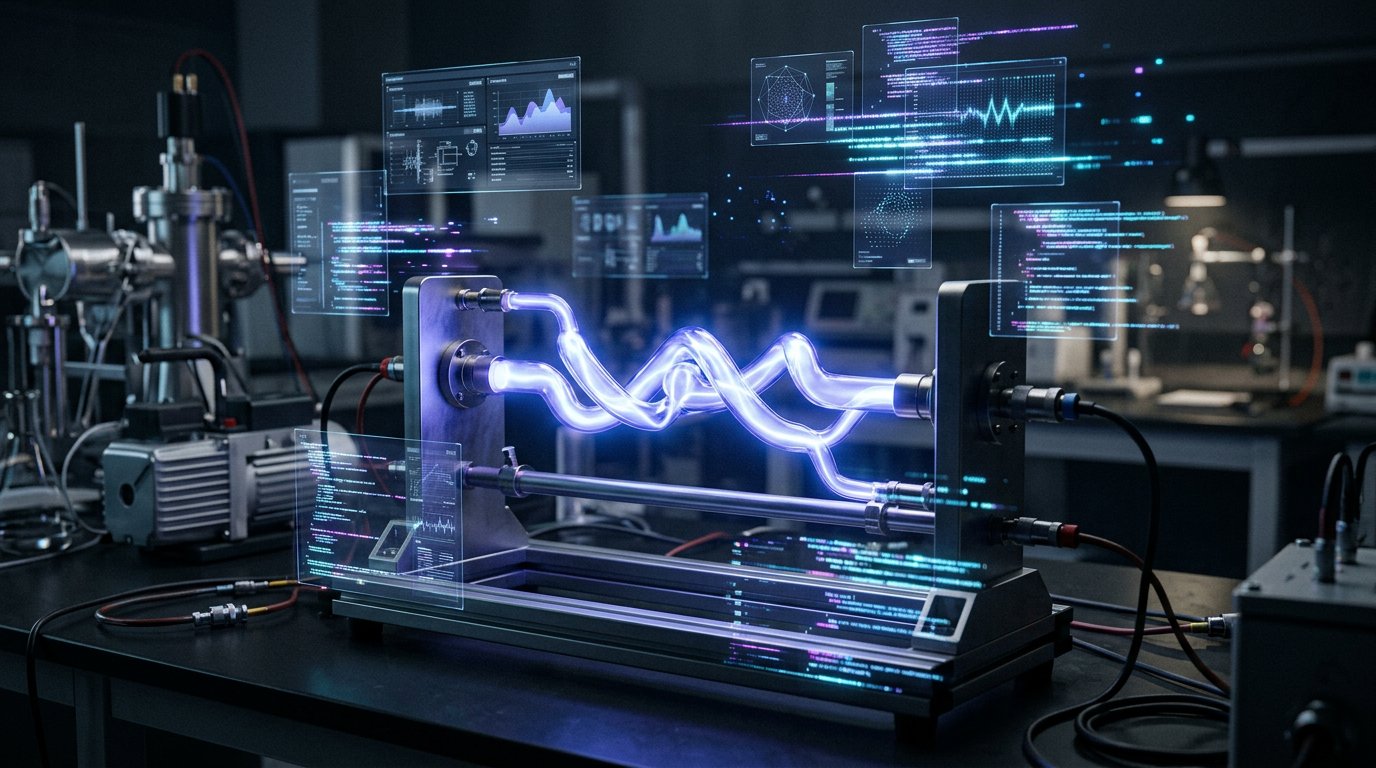
A glowing blue-violet gas discharge tube on a lab bench with floating holographic data panels
AI-generated illustration Google has added a third model to its Gemini 4 family, and it sits in a deliberately practical spot. Gemini 4 Neon, announced on November 18, 2026, is pitched as the model for complex, high-frequency work: long coding sessions, spreadsheet-heavy analysis and technical research. It is not the biggest model in the lineup, and that is the point. What Google announced In its launch post, Google describes Neon as bringing frontier-level intelligence with fast end-...
More

MIT’s Dry Bottlebrush Material Could Replace Ultrasound Gel

Translucent ultrasound patch on a neck with sound waves and an inset of bottlebrush polymer molecules
AI-generated illustration Anyone who has had an ultrasound knows the cold, sticky gel. It fills tiny gaps between the probe and skin so sound waves can pass through. For a doctor's visit that is fine, but for a wearable patch meant to image continuously the gel is a weak link, because it dries out within a day or two. On November 19, 2026, MIT engineers and colleagues reported a dry, stretchy replacement in the journal Science. What the team built According to MIT News, engineers at M...
More

Siemens SIRIUS 3QC1: Hybrid DC Contactor for 1,500 V Grids

Compact gray DC switching module mounted on a battery storage rack with an electric truck charging bay behind glass
AI-generated illustration Every battery storage site, megawatt truck charger and solar-plus-storage microgrid has to switch large direct current on and off safely. That job is harder than it sounds, because DC current has no natural zero crossing and tends to leave a stubborn arc behind when contacts open. On November 20, 2026, Siemens announced what it calls the world's first semiconductor-based heavy duty DC contactor, the SIRIUS 3QC1, built for up to 1,500 V and 600 A. What Siemens...
More

SiMa.ai Palette 3.0 Targets 3.5x Faster Edge AI for Robots

Glowing AI chip module on a workbench sending light streams to a small drone and a wheeled robot arm
AI-generated illustration Robots and drones increasingly want to run language and vision models on board, but the chips inside them have strict limits on power and memory. On November 17, 2026, edge AI company SiMa.ai announced Palette 3.0, a software release it says squeezes more out of a single low-power chip, with speculative decoding that lifts generation speed by up to 3.5x. Everything below is drawn from SiMa.ai's own press release, so the performance claims are the company's and h...
More

Siemens Links Agentic AI to Adaptive 3D-Printing Production

Holographic gripper design beside a lattice 3D-printed robotic gripper in a bright automated factory
AI-generated illustration Designing a custom robot gripper normally means a human engineer tweaking geometry, running simulations and preparing files for a 3D printer, step by step, for every new job. Siemens now says an AI agent can orchestrate much of that chain from a plain description of the task. In a November 16, 2026 press release, the company laid out an end-to-end digital thread that links prompt-based engineering to an adaptive additive manufacturing production cell. The detail...
More

Forsee Power ZEN 8 LFP: Drop-In Battery for Compact Machines

Electric street sweeper with open battery bay beside a compact electric excavator in a city yard at dusk
AI-generated illustration Compact street sweepers and mini excavators do their work in the places where noise and exhaust bother people most: city streets, building sites, farm yards. Yet their batteries have been a tight squeeze to design. On November 18, 2026, Forsee Power announced ZEN 8 LFP, a lithium iron phosphate battery aimed squarely at that niche, and built so that existing customers can swap it in without redesigning their machines. The details below come from Forsee Power's o...
More

Amazon OpenSearch Memory Gives AI Agents Persistent Recall

Glowing translucent robot sending streams of light into a floating wall of data cards
AI-generated illustration Ask an AI agent the same question on Monday and again on Friday, and it often answers as if the two of you had never met. On November 18, 2026, AWS announced that Amazon OpenSearch Memory is generally available, a serverless capability meant to fix exactly that by giving agents persistent, searchable memory, according to the AWS announcement. What OpenSearch Memory does OpenSearch Memory is a new part of Amazon OpenSearch Service. It stores an agent's interac...
More

ZutaCore Z2O Cools AI Data Centers With Zero Water

Data center aisle with glowing translucent cooling tubes and rooftop dry coolers visible through glass
AI-generated illustration Power, not silicon, has become the ceiling on AI, and a surprising share of that power goes to moving heat. On November 16, 2026, at Supercomputing 2026 in Chicago, cooling specialist ZutaCore unveiled Zâ‚‚O, a waterless cooling architecture that it says collapses the entire thermal stack into a single loop, according to the company's Business Wire release. One loop from chip to rooftop Zâ‚‚O runs a unified two-phase loop from ZutaCore's direct-to-chip cold plate...
More

ASUS ProArt GR1X Mini PC Is Built to Host Local AI Agents

Compact silver mini PC with a soft purple glow sitting beside a monitor on a wooden desk
AI-generated illustration The always-on AI agent has a new home, and it is small enough to sit beside a monitor. On November 18, 2026, ASUS announced the availability of the ProArt GR1X, a mini PC built around the NVIDIA RTX Spark superchip and designed to keep local AI agents running around the clock, according to the ASUS Pressroom announcement. The pitch is simple: agents that read your files, drive your apps and call large models work best when they never go to sleep, and when every ...
More

MIT’s Flapping Microrobot Now Flies With Its Own Sensors

Tiny winged robot with a miniature circuit board hovering next to a sunflower
AI-generated illustration For a decade, MIT's tiny flying robots have been remarkably athletic, with bumblebee-like speed, agility and durability. They had one big limitation: they were tethered to a laboratory motion-capture system because they could not carry the electronics needed to know where they were. According to MIT News, that has changed. A new version carries its own sensors and computer and still flies precisely. Why weight was the obstacle The robot is roughly the size an...
More

Gemini 4 Hydrogen Gives Robot Arms a Faster, Cheaper Brain

Robot arm sorting snack packages from a conveyor beside a laptop showing a simulation
AI-generated illustration Building a robot application has long meant stitching together drivers, calibration scripts, simulators and perception code before a single useful task runs. On November 17, 2026, Google's Gemini Robotics team described a way to compress that work: a fast general model, Gemini 4 Hydrogen, paired with a new Robotics plugin for Google Antigravity. The company says a developer can go from a robot in a box to a working application in an afternoon. A faster model ...
More

Microsoft MAI Image 2.7 Edits Images at a Fraction of the Cost

Microsoft MAI Image 2.7 Edits Images at a Fraction of the Cost (illustration)
AI-generated illustration Image models are no longer judged only on how pretty a first draft looks. The question now is how well they handle the second, third and tenth edit, and what each picture costs at scale. On November 17, 2026, Microsoft AI answered both with the launch of MAI Image 2.7 and a faster, cheaper sibling, MAI Image 2.7 Flash. In its launch post, Microsoft AI says the models deliver frontier image generation and editing at a fraction of the cost of the leading competito...
More

Boise State’s 2D Alloy Ink Prints Tiny, Powerful Supercapacitors

Boise State's 2D Alloy Ink Prints Tiny, Powerful Supercapacitors (illustration)
AI-generated illustration Batteries get most of the attention in energy storage, yet they are not good at everything. They struggle with sudden, large bursts of current, they wear out after roughly 1,000 to 10,000 cycles, and they do not like the cold. At Boise State University, researchers have just reported a printable material that could help close those gaps from the other side, by making better supercapacitors that can be printed onto flexible surfaces. According to Boise State News...


More

Nikon MACHX Metal 3D Printers Chase Output Per Square Meter

Industrial metal 3D printer with several blue laser beams fusing powder beside a finished metal part
AI-generated illustration Metal 3D printing has long been sold on speed: how fast can a machine lay down layers? As the technology moves from prototypes into real production lines, manufacturers care about something else, namely how much they can make in a given patch of factory floor. On November 18, 2026, Nikon announced a new printer family built around exactly that idea. This article draws on Nikon's announcement of the MACHX series, developed by its subsidiary Nikon SLM Solutions AG...
More

Siemens WATTBLOC Builds Utility Solar From Modular Inverter Blocks

Utility-scale solar farm at sunset with modular inverter units and a transformer in the foreground
AI-generated illustration Utility-scale solar plants are getting bigger, and the equipment that turns their direct current into grid-ready power is under pressure to be more flexible, easier to service and quicker to expand. On November 16, 2026, Siemens answered with WATTBLOC, a U.S.-assembled platform that rethinks how a solar plant converts power by building it from small, independent blocks. This article draws on Siemens' press release from Las Vegas. Performance figures below are th...
More

Perplexity Orchestrator: One API for Frontier and Open Models

A glowing central hub sending streams of light to many glass orbs representing different AI models
AI-generated illustration Anyone building with AI in 2026 faces the same quiet headache: new models arrive every few weeks, each from a different provider with its own account, contract, key and invoice. On November 17, 2026, Perplexity launched an answer: the Orchestrator API, which puts frontier and open-weight models behind a single endpoint with unified billing and automatic failover. This article draws on Perplexity's launch post. The performance statements below are the company's o...
More

Caltech’s Nanosyringes Inject Working Proteins Into Plant Cells

Translucent glowing syringes releasing luminous particles into the surface of a green leaf
AI-generated illustration Getting a useful protein into a plant cell is surprisingly hard. Every cell is wrapped in a rigid wall and a membrane, and most delivery tricks either rely on inserting DNA or struggle to get past those barriers. On November 18, 2026, Caltech announced a different route: bacterial "nanosyringes" that have been re-aimed at plant cells and loaded with working molecular tools. The work, led by Gozde Demirer's lab in chemical engineering, appears in Nature Nanotechn...
More

Panopto Develop Turns Recorded Expertise Into AI-Built Courses

Stylized video tiles and checklists flowing from a screen into a neatly organized course stack with progress bars
AI-generated illustration Training teams are being asked to do more with less. Citing SHRM's 2026 benchmarking research, Panopto says median learning and development spending per employee fell 28% from 2025, while training hours stayed the same. On November 17, 2026, the video knowledge company announced Panopto Develop, a new offering meant to ease that squeeze by turning expertise people have already recorded into structured courses. What Panopto Develop does According to Panopto's ...
More

Penn’s Self-Sensing Artificial Muscles Give Soft Robots Fine Control

Robotic hand wrapped in blue and copper coiled fibers pressing piano keys next to a small mechanical eye module on a lab bench
AI-generated illustration A robotic finger presses a piano key, pauses, and moves on to the next note. Nearby, an artificial eye shifts its gaze through a series of small, controlled steps. According to Penn Engineering, both demonstrations rely on a new kind of artificial muscle that can sense its own state, hold intermediate positions, and coordinate with other muscles. The work, announced on November 12, 2026, comes from teams led by Shu Yang and Cynthia Sung. It is a small-scale stor...
More

Alibaba Qwen4-Max: 2.4T Parameters, Only 71B Active per Token

Glowing orange cluster of lit nodes within a vast dark blue neural network above a circuit-like landscape
AI-generated illustration Alibaba has released Qwen4-Max, and the pitch is less about being the biggest model and more about doing more work per token. Announced on November 16, 2026, the new flagship of the Qwen family has 2.4 trillion total parameters, native vision and a one-million-token context window, yet it activates only 71 billion parameters for each token it processes. What Alibaba released Per Alibaba Cloud's press release, Qwen4-Max is the most capable model in the Qwen fa...
More

Moment Energy Nova Puts Retired EV Batteries on the Grid

Row of white outdoor battery storage cabinets beside a modern office building at sunset with a pallet of used EV battery packs in front
AI-generated illustration Most grid batteries start life as new cells. Moment Energy is betting that the better source is already on the road. On November 17, 2026, the company unveiled Nova, a commercial battery energy storage system (BESS) built from repurposed electric vehicle batteries, and said it is the first of its kind to earn both UL 1973 and UL 9540 certification. Those two safety listings matter because they are what lets a stationary battery sit next to a hospital, an airport...
More

NVIDIA Nemotron for Science Gives Labs an Open Agent Toolkit

A compact AI computer beside glowing molecule graphics and a robotic arm handling lab glassware
AI-generated illustration Scientific work is full of tasks that are tedious for people and awkward for general chatbots: reading reaction diagrams, planning lab protocols, repairing a broken simulation setup. On November 16, 2026, NVIDIA introduced Nemotron for Science, a bundle of an open model, a new chemistry dataset and post-training recipes aimed at helping researchers build agents for those jobs. What is in the package As described in NVIDIA's announcement, Nemotron for Science ...
More

KAIST Battery Electrode Turns Curved Drone Legs Into Storage

A quadcopter drone on a lab bench with one curved carbon-fiber leg cut away to show a glowing woven battery layer
AI-generated illustration Most drones and robots carry their energy the way a hiker carries a water bottle: as a separate load strapped onto a frame that does its own job. A new electrode from KAIST points to a different idea, where a landing leg or a robot limb is also part of the battery. The catch has always been shape, because real frames are curved and hollow. On November 18, 2026, KAIST announced an electrode built to work in exactly those places. What KAIST built According to K...
More

PAN 2: An Open World Model That Simulates What Happens Next

PAN 2: An Open World Model That Simulates What Happens Next editorial illustration
AI-generated illustration A language model predicts the next word. A world model tries to predict the next moment of the world itself. On November 10, 2026, the Institute of Foundation Models (IFM), established by Mohamed bin Zayed University of Artificial Intelligence (MBZUAI), released PAN 2, an open, general-purpose world model aimed at physical intelligence. The pitch is simple to state: give PAN 2 a starting scene and an action described in words, and it simulates a video of what ha...
More

Gemini Robotics 2.5: Faster Learning and a 96% Factory Pilot

Gemini Robotics 2.5: Faster Learning and a 96% Factory Pilot editorial illustration
AI-generated illustration Teaching a robot to tie a bow on a gift box sounds like a party trick. Teaching it to do that, pipette a liquid, and then sort metal brackets on a car assembly line without falling apart is something else. On November 10, 2026, Google DeepMind introduced Gemini Robotics 2.5, which it calls its most capable vision-language-action (VLA) model to date, and put numbers on that ambition. According to DeepMind's announcement, the model widens the range of skills a rob...
More

AKU’s Machine Learning Maps Hidden Diabetes Risk Groups

AI-generated illustration Every hospital discharge leaves behind a trail of diagnosis codes. Most of the time those codes are used for billing and then forgotten. A team at Aga Khan University (AKU) in Karachi asked a different question: if you hand fourteen years of those codes to an unsupervised machine learning algorithm, will it find patterns that doctors and hospital planners should care about? The answer, published in BMJ Open, is yes. Working with records from 78,271 adults with d...
More